

About This Project
This is an article on taste science written by James, our resident Bar40 food scientist. The purpose of this article is to give a strong scientific background in how humans perceive flavour and to gain an understanding of how flavours can mesh together.
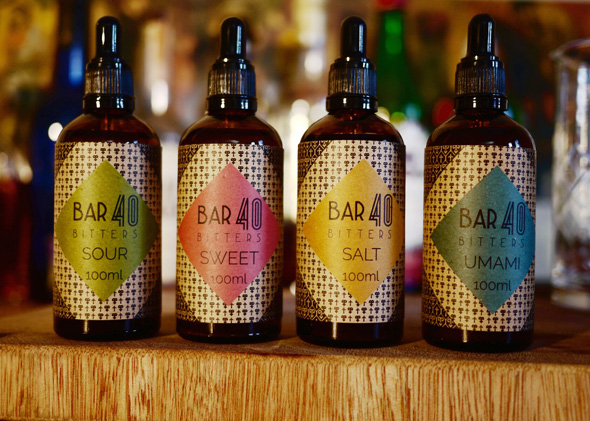
Use this article as a tool, just like how you use Bar40 Bitters as a tool, to create purpose behind your cocktails.
The Five Senses & Multimodal perception
There is more to food than just how it tastes, in fact all five of our senses come in to play when perceiving food. Receptors in our retinas are able to interpret signals based off light waves in order to perceive different colours, shapes, and sizes of objects. Gustation perceives non-volatiles compounds when dissolved in water, oil, or even saliva which is then detected by taste buds located not only on the tongue but on other areas of the mouth and throat too. These can be perceived as either sweet, salty, sour, bitter, or umami. Volatile molecules are sensed by the olfactory receptors that are covering our nasal cavity and epithelium. Whether that be a single compound such as menthol known for its minty scent or a combination of the tens of thousands of different known volatile compounds. The sense of touch can be broken down into two categories; somesthesis and chemesthesis, the former being the sensations related to contact and touch on the skin while the latter is the sensation by chemical substances on the same nerves. A common example of this is piping hot food versus capsaicin found in chili peppers, the stimulation of trigeminal nerves (physically – hot foods, chemically – capsaicin) in the mouth to give a hot/burning sensation for both cases. The last sensory perception is audition, sensed by millions of tiny hair cells in the ear stimulated by vibrations. These sound waves created from touching food, or the noise made from eating food (known as intra-oral perceptions) contributes to the perceived texture of the food whether that is crunchy or smooth.
Multimodal perception is the combination of these senses, as with all aspects of food more than one sense is used to appreciate. When we perceive flavour were not just sensing the taste but it’s the interaction of taste, aroma, texture, appearance, and sound all coming together. Something to keep in mind the next time you’re sipping your favourite cocktail, taste the sweet, sour, and bitter compounds, smell the notes of bitters and spices, feel the coolness of the glass on your fingers and the viscosity of liquid in your mouth, while listening to the ice hitting the glass and the cocktail being ingested.
Gustation & Olfaction
There are five basic taste qualities that we can perceive, sour, salty, sweet, bitter, and umami. Although there are thousands of flavours that can be found in foods, the root of all these can be traced down to these 5 qualities as well as our olfactory senses. The five basic tastes are mediated by gustatory receptor cells. These cells along with basal cells make up an onion shaped structure known as taste buds, at the tip of each taste bud there is an opening pore where gustatory hairs protrude. Groups of taste buds are found on the small bumps found coating the surface of our tongue called papillae. There are four types of papillae; filiform, fungiform, foliate, and circumvallate. While filiform papillae are the most abundant on our tongues, they do not contain taste buds and are involved in tactile sensations. The three remaining papillae all house taste buds. Fungiform papillae are found on the front of the tongue and are mushroom shaped red spots. Each fungiform papilla contains 2-3 taste buds. The foliate papillae are leaf like in shape and appear as small ridges on the sides of the tongue, these ridges contain about 600 taste buds per side. Lastly are the circumvallate papillae, these are found at the back of the tongue and contain 250 taste buds each. Once the non-volatile (flavour) molecules are mixed with a liquid (water, oil, saliva) they enter the taste pores and interact with gustatory hairs and stimulate the taste receptor cells which send impulses to the gustatory area of the brain. Contrary to outdated textbook knowledge there are roughly 10,000 taste buds found not only on the surface of the tongue but around the inside of the mouth and esophagus as well. Although certain receptors are more sensitive to different tastes, all five senses can be recognized on any of the tongue as the taste bud containing papillae have receptors for all five sensations.
Mirroring the perception of non-volatile compounds via gustation, olfaction is the stimulus from volatile food compounds (aromas). This can be orthonasal (through the nose) or retronasal (through the oral cavity as food is eaten), making it a complex sensation since volatile compounds are continuously being released as food is broken down in our mouths mechanically (chewing) as well as enzymatically. The volatile compounds are continually released and sensed retronasally as we eat. Throughout the nasal cavity and olfactory epithelium there are many small appendages that protrude at the end of each of these are bulb like structures. Each of these bulbs contains 20-30 very fine cilia containing olfactory receptors which transmit olfactory signals to the brain when odour molecules bind to the receptor proteins.
Combining these two senses our brain uses information being received both through gustation and olfaction in order to tell us how food tastes.
The 5 Gustatory Senses
Sour
Strong sour taste can be repulsive and in history would prevent the ingestions of unripe produce or spoiled foods which would often contain acids. Sour taste is induced by acids but the strength of sourness is not always proportional to the pH or measure of acidity of a substance. For example at the same pH acetic acid (vinegar) is perceived to be more sour than hydrochloric acid. Current research indicates two groups of sour taste receptors, one is an acid sensing ion channels promoting the intake of protons into the cell while the other involves the depolarization of potassium channels, in both cases this allows calcium ions to enter the cell and create an electric current which is transmitted to the brain. Although more research still needs to be done in regard to the perception of sour taste it can be noted that there is a push for the declaration of a sixth sense of taste being calcium which involves these calcium ion receptors that are believed to detect sour. A very low threshold is needed to detect sourness, many believe this is because like bitter compounds, over time we have become accustomed to detecting it in food and using it as a warning sign which would prevent early humans from eating foods that could harm them. But another reason may be unlike sweet and salty compounds that have less detectable forms, our taste buds are able to detect a handful of different forms of sour compounds which could also be why they are easily detected. With this being said the addition of a small amount of a sour compound in a cocktail can go a long way, even though it is not known to strengthen the taste perception of the other 4 gustatory senses specifically. The acid compounds cause an increased amount of saliva to be released which in turn helps to distribute non-volatile compounds to the taste receptor giving a full or round taste to a cocktail. Should a cocktail be too sour, sweetness easily is able to suppress the taste because it is the most dominant of the 5 gustatory senses. With the knowledge that salt is able to improve the recognition of sweetness the addition of both sugar and salt can efficiently balance a sour taste in a cocktail.
Salt
The taste of salt is believed to be mediated by the epithelial sodium channel. This releases calcium ions inside the cell making it positively charged, producing an electric current which is transmitted to the brain. Sodium is not the only salt that can impart the salty taste, lithium and potassium are examples of other ions that also impart saltiness (to a much lesser extent) suggesting that there is more than one receptor that perceives salt. Due to the similar method of receptors it is often difficult for individuals to distinguish between salty and sour at lower concentrations. Salt is very common in our diet especially in North America, because of this we have slowly built a tolerance to its taste and don’t recognize it as easily as bitter or sour compounds. But as with sour, salt also promotes the release of saliva helping to perceive flavours. Not only does the production of saliva help with flavour perception but the change in viscosity is also recognized by the trigeminal nerves. The increased viscosity due to the promoted secretion of saliva creates a desirable mouth feel, compared to a drink that is less viscous and similar to water which is perceived to be watered down, not only in texture but flavour as well. A viscous mouth feel leads to longer interactions with taste buds as well as a satisfying mouth feel leaving a rounded overall experience. Unlike the other 4 compounds, salt is able to suppress bitter and sour flavours while strengthening sweetness, without the addition of salt a cocktail containing any combination of these 3 flavours can often taste muddy and flat as sour, bitter, and sweet will combine to suppress each other in taste. Salt can be used at such low levels that it doesn’t have to be detected in order for its functionality to be of use, meaning a drink doesn’t have to taste salty in order for the suppression of sour and/or bitter compounds or an increase in sweetness to be noted. Salt is also very easy to mask, by heightening the perception of sweetness it can be suppressed easily by sugar. To a lesser extent sour and bitter act to suppress salt when there is too much of it present. Salt also suppresses the bite from alcohol, rendering a smooth flavourful drink with its addition.
Sweet
Sweet compounds are associated with ripe, rich, and great tasting foods that easily overpowers other flavours especially when used in excess. Sweetness is detected by a G-protein (signal transmission) receptor, where only one form of sweetness is perceived. With only one form being perceived it is very hard to supress sweetness with other tastes, whether that is in a simple drink containing two gustatory senses or something with a more complex flavour profile. With that being said the addition of sweetness really helps to round out a cocktail, a small amount of sweetness can help to make a cocktail more palatable by cutting some of the harsh overwhelming tastes that can be found in salty, sour, and more noticeably bitter taste profiles. Like salt, the North American diet has also been pumped with sugars and a larger amount is needed in order for us to detect it. There’s even an argument that we always expect to have some amount of sweetness in anything we consume today. Keeping in mind that of the 5 senses sweetness is the hardest to supress, especially when it is in excess so the addition of sugar should be used wisely. That’s not to say that sugar shouldn’t be added to a cocktail as it can improve flavours and palatability but like all of the 5 gustatory senses balance is the key. In comparison to bitter, sweetness is on the opposite end of the flavour spectrum, even though they both balance each other out sweetness is widely more accepted over bitterness. Although sweetness may seem very one directional it does work well with all 5 senses, for example caramelization reactions add bitter components to the flavour profile of sugars yet the caramel taste of bruléed sugar in a cocktail or on the rim of a glass can change the whole perception of the drink. The great thing about sweetness is that either at high or low concentrations it will add body and improve palatability of any drink depending on preference.
Umami
Umami strongly enhances the palatability of food, most notably perceived by glutamic acid a compound that is enriched during the ripening process of many foods such as produce, cheeses, and meats. Umami although not yet fully understood has been in foods just as long as the other 5 senses but was most recognized and utilized in oriental cuisine. It is often described as savoury or earthy, with a rich yet subtle taste that pairs well with any of the other 4 gustatory senses. Glutamate is also found in MSG which is a reason why it was added to several foods commercially, the unfamiliar taste of umami and the impact it had on the flavour profile made MSG synonymous with addicting foods, but have no fear umami compounds aren’t harmful to the body nor are they addicting, except for their great taste that is. Glutamic acid or glutamate is recognized by several different metabotropic glutamate receptors, allowing for several different forms of umami to be perceived. When glutamate receptors are activated there is a larger release of calcium and sodium ions which depolarize the cell this helps to enhance the perception of other flavours thus rounding out a flavour profile. Umami is unique in that not only does it improve all 5 gustatory senses but it also enhances chemesthesis receptors as well (sense of touch). It strengthens salt and sweetness yet can take some of the bite out of sour and bitter compounds without drastically changing the flavour of them. Umami doesn’t necessarily change the texture of foods but it does change how the texture is perceived, for example a drink containing umami will taste more bodied and thick. Improving a drink by making it taste less watery without changing its consistency all while making the perception of the other 5 senses better.
Bitter
Perception of bitter compounds can vary greatly between individuals, some are highly sensitive whereas others can’t even taste them. In fact approximately 25% of people are supertasters, meaning these individuals are so sensitive to taste that bitter compounds are too overwhelming for them and can be unpalatable. This can be related to the composition of receptors found the in papillae as well as the amount of papillae present. There are over 300 forms of bitter compounds that we can perceive. Unlike other tastes, bitter taste receptor cells are more tuned to respond to specific bitter molecules, in the sense that the receptors can respond to one specific type of bitter compound but not another. Of the 5 gustatory senses bitter is the easiest to detect by far so only a small amount is ever needed. Like sour tasting foods, throughout time foods that tasted bitter have been associated with being bad or poisonous thus were avoided. But bitter compounds are very important, not only do they add another dimension to a flavour profile they also are able to suppress all the other tastes which helps to bring the flavours together without a harsh or muddled taste. The vast amount of bitter compounds we can perceive using specific receptors allow for the taste of bitter to be identified not only at different time intervals but also at different intensities. Bitter compounds increase the amount of enzymes that are being released for digestion, because our body associates bitter compounds with bad or raw foods more enzymes are excreted to easily break down the food. With different non-volatile compounds being broken down and released in our mouth this is where bitter compounds can really shine preventing a drink from becoming harsh or overwhelming by a single flavour. Bitter compounds typically add that missing something that can often be noted in some cocktails, without overpowering the intended flavours a bitter compound can produce a well-rounded drink with enhanced flavours.